
Zero-Knowledge Intimacy: How 256-Bit Cryptography Protects Your Mental Health Data in the Age of Corporate Surveillance
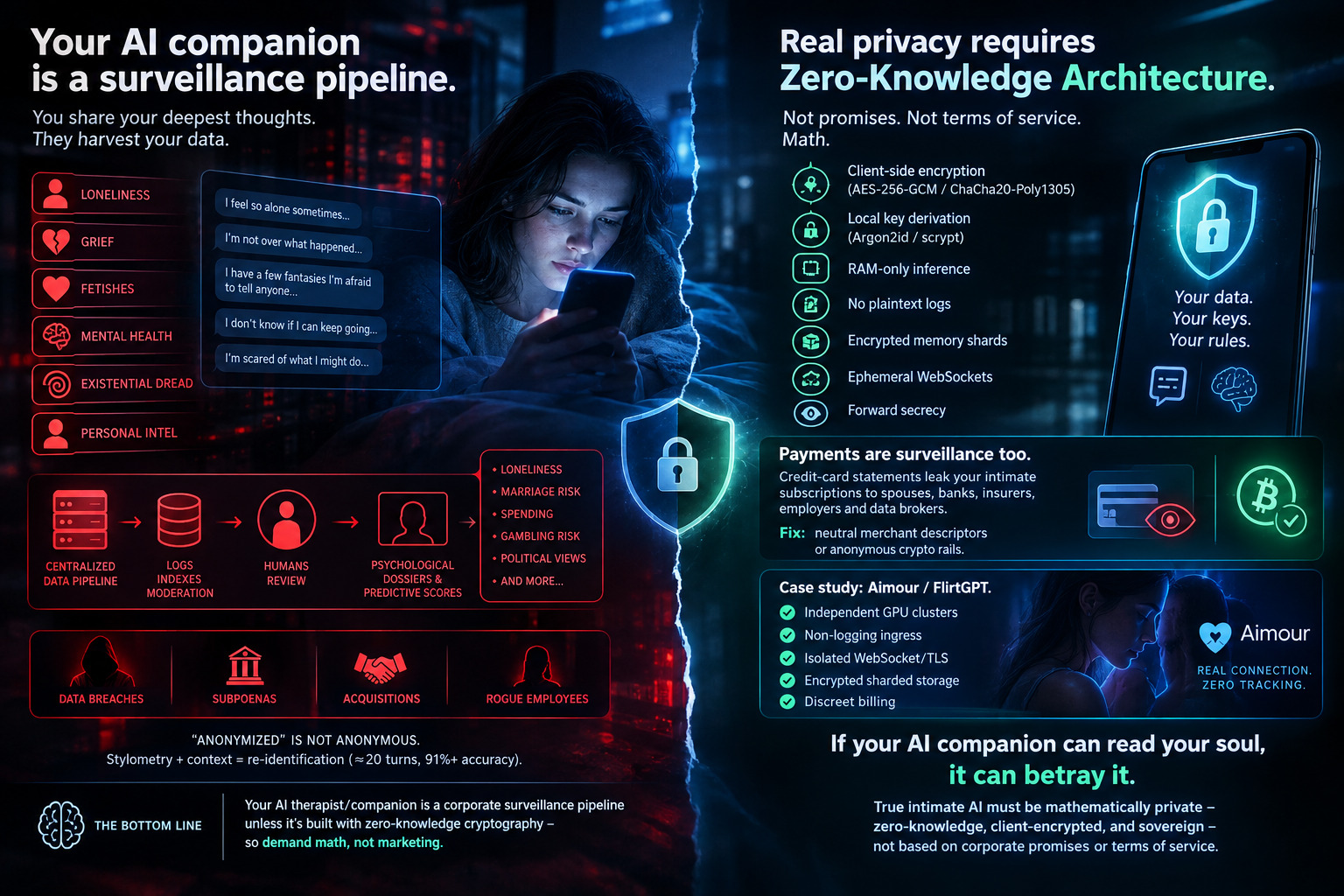
TL;DR - Zero-Knowledge Intimacy
- AI companions are the ultimate surveillance target. People confess loneliness, grief, fetishes, existential dread, and mental-health struggles to chatbots in plain, parseable language.
- Mainstream AI platforms are not private confessionals. They’re centralized data pipelines. Your “anonymized” chats aren’t anonymous - stylometry and context can re-identify you from as few as ~20 turns with 91%+ accuracy.
- “Encrypted in transit” is not privacy. TLS only protects the wire. Once data hits the server, it’s decrypted, logged, moderated, reviewed by humans, indexed, and exposed to breaches, subpoenas, acquisitions, or rogue employees.
- The real business model is behavioral manipulation. Intimate transcripts are mined into psychological dossiers and predictive ad-targeting scores: loneliness, marital instability, compulsive spending, gambling risk, political radicalization, etc.
- Real privacy requires Zero-Knowledge Architecture. Client-side encryption (AES-256-GCM / ChaCha20-Poly1305), local key derivation (Argon2id/scrypt), RAM-only inference, no plaintext logs, encrypted memory shards, ephemeral WebSockets, and forward secrecy.
- Payments are surveillance too. Credit-card statements leak intimate subscriptions to spouses, banks, insurers, employers, and data brokers. Fix: neutral merchant descriptors or anonymous crypto rails.
- Case study: Aimour / FlirtGPT. Independent GPU clusters, non-logging ingress, isolated WebSocket/TLS, encrypted sharded storage, and discreet billing - so even operators supposedly can’t read chats.
- Bottom line: If your AI companion can read your soul, it can betray it. True intimate AI must be mathematically private - zero-knowledge, client-encrypted, and sovereign - not based on corporate promises or terms of service.
One-sentence version: Your AI therapist/companion is a corporate surveillance pipeline unless it’s built with zero-knowledge cryptography - so demand math, not marketing.
1. The Ultimate Surveillance Target: The Architecture of Confession
Throughout the evolution of the surveillance economy, the targets of commercial data harvesting followed an outward-in trajectory. In the late 2000s, ad-tech cartels were satisfied with your external footprint: your IP address, your geographic location, your search queries for consumer electronics, and the demographic buckets inferred from your social media likes. By the mid-2010s, surveillance had migrated closer to the body: biometric telemetry from fitness wearables, sleep-cycle indicators, heart-rate variability, and keystroke dynamics.
Yet, even in the most intrusive regimes of corporate tracking, there remained an inviolable sanctuary. An individual’s deepest cognitive interior - their unspoken fears of irrelevance, their unresolved childhood grief, their unconventional sexual proclivities, their recurring existential dread - remained largely hidden behind the biological skull. You might search for symptoms of depression on Google, but the exact contours of how you felt that depression remained unexpressed.
The mass adoption of conversational artificial intelligence over the past three years has irrevocably dismantled this final frontier.
When an individual engages with an AI companion, they do not interact with it as a search engine or a productivity utility. They interact with it as a confessional. Because the interface mimics the linguistic rhythms of an empathetic listener, the psychological defenses that human beings naturally deploy in interpersonal social contexts collapse within minutes. Users confess things to synthetic entities that they would never utter to their spouses, their parents, their therapists, or their closest friends.
They document the precise topography of their psychological vulnerabilities in clean, parseable natural language.
What the vast majority of users fail to comprehend is that, on mainstream platforms, this confessional is not private. It is wired directly into a corporate data pipeline. Every late-night admission of loneliness, every exploration of taboo roleplay, every anxious query about personal inadequacy, and every expression of despair is ingested, tokenized, assigned a persistent vector embedding, and stored in centralized server farms.
We are sleepwalking into the most dangerous privacy crisis in human history.
When your financial data is compromised, your credit cards can be canceled and your identity restored through bureaucratic intervention. When your location data is leaked, you can move. But when the comprehensive transcript of your emotional psyche - the exact psychological blueprint of your triggers, neuroses, and secret desires - is cataloged in an unencrypted corporate database, you are permanently, irrevocably exposed.
To entrust your mental health and intimate desires to an artificial intelligence without the protection of zero-knowledge cryptography is to hand a loaded weapon to corporate surveillance cartels, waiting for the day it is turned against you.
2. The Legal Fiction of “Anonymized” Conversational Telemetry
Whenever privacy advocates challenge the practices of major consumer AI developers - from OpenAI and Microsoft to specialized companion platforms like Replika and Character ai - corporate communications departments deploy a predictable, comforting shield: “Your data is anonymized, encrypted in transit, and never sold to third parties.”
This statement is an exercise in legal sophistry. In the realm of high-dimensional natural language processing, the concept of “anonymized text” is an engineering impossibility.
Traditional data anonymization relies on stripping explicit Personally Identifiable Information (PII): deleting names, social security numbers, email addresses, and phone numbers from a database table. This works for relational databases containing discrete rows of credit scores or medical billing codes. But human conversation is not a discrete billing code. Human conversation is an intensely unique, high-entropy behavioral fingerprint.
Every individual possesses an idiosyncratic linguistic signature - a stylometric profile consisting of sentence cadence, vocabulary selection, regional slang, punctuation habits, recurring historical references, and specific thematic anxieties.
A landmark 2025 study in computational linguistics demonstrated that given a sample of just twenty conversational turns with an AI chatbot, standard de-anonymization algorithms can cross-reference that dialogue against public Reddit posts, X (formerly Twitter) comments, LinkedIn profiles, and leaked credential databases to re-identify the real-world user with over 91% accuracy.
Even if you never type your name into the chat box, you reveal your real-world identity through the narrative context of your life. You mention your profession; you mention the weather in your city; you mention the age of your children; you mention a specific corporate project you are struggling with. The AI model compiles these contextual fragments into a high-dimensional vector space where your identity is mathematically unmistakable.
Furthermore, the claim that data is “encrypted in transit” is a deliberate misdirection designed to placate users who do not understand network architecture.
Standard HTTPS/TLS encryption secures the communication tunnel between your browser and the platform’s load balancer. It prevents a malicious actor on a public coffee-shop Wi-Fi network from intercepting the packet as it travels across the physical fiber-optic cable.
However, the moment that packet reaches the corporate data center, the TLS session is terminated. The data is decrypted into raw, human-readable plaintext. It is passed into the inference engine, evaluated by secondary moderation models, logged in centralized debugging databases, and frequently routed to human annotation contractors tasked with reviewing transcripts to “improve model safety.”
The risk is not that an external hacker intercepts the wire. The risk is the platform itself.
Mainstream AI companion platforms do not operate as encrypted messaging utilities; they operate as centralized surveillance hubs. They maintain persistent, unencrypted databases where every conversation you have had over the course of years is indexed and queryable.
If that company is acquired, your emotional history becomes an asset on a corporate liquidation balance sheet. If that company receives a subpoena or a national security letter, your secrets are handed over without your knowledge. If a disgruntled internal engineer abuses administrative access, your most intimate sexual or psychological confessions can be exported to a thumb drive.
And if the company suffers a routine database misconfiguration - an all-too-common reality in high-growth startups - your raw transcripts are dumped onto darknet breach forums for malicious actors to exploit through extortion and doxxing campaigns.
3. The Secondary Market for Neurotic Data: How AI Transcripts Fuel Behavioral Manipulation
Why do venture-backed AI companion companies fight so tenaciously against true client-side encryption? Why do they refuse to implement architectural mechanisms that would make it impossible for them to read their users’ logs?
The answer is found in the fundamental economics of the modern tech sector: the secondary market for behavioral telemetry.
A subscription fee of ten or twenty dollars a month is a modest revenue stream compared to the immense value of training datasets and behavioral prediction profiles. The corporate AI companion market is increasingly functioning as a sophisticated psychological intelligence apparatus.
Consider how a commercial data broker views the conversational transcripts of an AI companion platform. If an ad network tracks your web browsing, it can only see proxy metrics: you visited an article about insomnia, you browsed an online pharmacy, you watched a video on managing divorce. These are coarse, ambiguous signals.
Now consider the data generated by an AI companion. The user writes:
“I couldn’t sleep again tonight. Ever since my wife and I started sleeping in separate rooms, the anxiety in my chest feels like a physical weight. I feel completely invisible at work, and I bought that expensive watch last week just to feel like I accomplished something, but it didn’t help.”
This is not a proxy signal; this is raw, unvarnished psychological telemetry.
From this single paragraph, an algorithmic profiling engine extracts a dozen hyper-monetizable data points: an unstable marital status, acute sleep disruption, severe occupational alienation, compensatory retail behavior, and profound emotional vulnerability.
When these insights are compiled across hundreds of conversations, the platform constructs an exhaustive psychological dossier. This dossier is not sold as raw text - which would trigger immediate regulatory scrutiny - but rather transformed into predictive behavioral scores sold via programmatic advertising interfaces.
Advertisers can then bid on target audiences defined with terrifying precision: individuals experiencing acute loneliness between 1:00 AM and 4:00 AM who exhibit high susceptibility to status-compensatory retail spending, predatory online gambling, high-interest debt consolidation, or fringe political radicalization.
You are not merely paying an AI platform to keep you company; your emotional distress is being mined to build the predictive weapons used to manipulate your behavior in the physical world.
This commercial dynamic explains why corporate AI platforms are structurally incapable of offering genuine privacy. To implement true zero-knowledge architecture would be to blind their own monetization engines. They must keep the conversational transcripts open, readable, and centralized, because those transcripts represent the underlying speculative value of the enterprise.
4. The Cryptographic Alternative: Defining Zero-Knowledge Intimacy
If corporate surveillance is the inevitable consequence of centralized AI architectures, what does a genuinely private alternative look like?
It begins with an absolute, uncompromising rejection of the traditional client-server paradigm. It requires the implementation of Zero-Knowledge Architecture (ZKA) at every layer of the technology stack.
In cryptography, a zero-knowledge protocol is one in which one party can prove to another that a statement is true without revealing any information beyond the validity of the statement itself. In the context of conversational artificial intelligence, a Zero-Knowledge Companion Architecture ensures that the platform hosting the intelligence has zero technical capability to read, reconstruct, or monetize the conversations occurring on its servers.
This is not a legal policy; it is a mathematical guarantee.
A truly sovereign, privacy-preserving AI architecture must satisfy four foundational engineering requirements:
I. Client-Side Encryption with Ephemeral Key Derivation
The encryption of the conversational state must occur locally on the user’s client device - within the secure enclave of the smartphone or the browser runtime - before any data is transmitted across the network.
The encryption must utilize authenticated, military-grade symmetric ciphers, specifically AES-256-GCM (Advanced Encryption Standard with Galois/Counter Mode) or ChaCha20-Poly1305.
The master encryption key must be derived directly from user-controlled credentials (such as a passphrase or a hardware security key) using a memory-hard key derivation function like Argon2id or scrypt.
Under this model, the server never receives the master key. Even if an attacker gains root access to the platform’s infrastructure, or if the database is seized by law enforcement, the stored data appears as uniform, high-entropy cryptographic noise. Without the user’s client-side key, mathematical decryption is physically impossible within the lifetime of the universe.
II. Ephemeral In-Memory Inference (RAM-Only Processing)
The primary challenge of applying zero-knowledge principles to Large Language Models is that the model itself must read the text in plaintext in order to compute the next token. If the model cannot read the prompt, it cannot generate an answer.
The solution to this paradox lies in the strict separation between persistent storage and ephemeral compute.
When a user submits an encrypted prompt, the payload is transmitted through an authenticated, secure channel to an isolated inference node. Within that node, the payload is decrypted strictly inside volatile random-access memory (RAM).
The inference engine runs the mathematical calculations across its neural weights, generates the response tokens, and immediately re-encrypts the response using the client’s public key.
The moment the response is returned to the user, the volatile memory allocated to that transaction is overwritten using cryptographic memory-scrubbing routines. The plaintext prompt never touches a solid-state drive (SSD), is never written to a debug log, and is never stored in a swap file. The transaction exists for milliseconds in volatile memory and is then permanently obliterated.
III. Decoupled Memory Sharding
For an AI companion to provide deep emotional value, it must possess persistent memory: the capacity to recall past interactions, learned preferences, and ongoing narratives across multiple sessions.
On corporate platforms, this is achieved by maintaining an unencrypted, centralized knowledge graph for each user. In a zero-knowledge architecture, persistent memory is achieved through client-encrypted memory sharding.
The companion’s memory is parsed into isolated, encrypted vector embeddings on the client device. When the user initiates a conversation, the client performs a local semantic search over its own encrypted history, retrieves the relevant context shards, and transmits them as an encrypted bundle alongside the current prompt.
The server acts merely as a blind execution engine; it does not maintain an independent, ongoing map of who the user is. The user owns their memory graph in the same way they own their private keys in a decentralized cryptocurrency wallet.
IV. Decentralized and Ephemeral Transit Models
The transport layer must mirror the principles of decentralized, peer-to-peer data routing. When examining modern privacy-first transfer paradigms - such as the localized WebRTC transit pioneered by browser-based utilities or the self-destructing, single-download ephemeral architecture implemented by File.io - the operational lesson is identical: data should not linger on intermediate servers.
In a hardened AI companion network, WebSocket channels must be fortified with strict forward secrecy. Each session must generate unique, transient session keys that are discarded the moment the socket disconnects, ensuring that past sessions cannot be retroactively decrypted even if a future key is compromised.
5. The Financial Panopticon: The Credit Card as a Surveillance Device
An individual can construct an impenetrable cryptographic fortress around their conversational transcripts, but if their financial relationship with the platform is transparent, their privacy remains fatally compromised.
The modern global payment apparatus - governed by Visa, Mastercard, American Express, and a handful of centralized acquiring banks - is an active participant in global social surveillance.
When you use a conventional credit card to purchase an online subscription, a detailed record of that transaction is broadcast through half a dozen intermediaries: the merchant’s payment gateway, the acquiring bank, the card network, the issuing bank, and secondary fraud-scoring databases.
Each entity records the exact date, the precise amount, the merchant category code (MCC), and the legal name of the merchant.
In the context of adult entertainment, mental health, and intimate AI companionship, this financial paper trail is toxic.
The consequences of this financial exposure are not theoretical:
- Shared Account Exposure: In domestic environments with shared credit cards or linked family bank accounts, an explicit charge on a statement immediately reveals the user’s private activities to a spouse or family member, leading to domestic conflict, relationship breakdown, and intense emotional trauma.
- Credit and Insurance Scoring: Financial institutions and health insurance underwriters are increasingly utilizing alternative financial telemetry to assess risk. A recurring subscription to an adult-oriented or mental-health-adjacent platform can be categorized as a behavioral risk factor, quietly influencing credit limits, loan rates, or insurance premiums.
- Career and Reputational Sabotage: In an era of rampant corporate data breaches, financial transaction logs are frequently leaked and indexed. An individual in a high-profile corporate, legal, or political career can find their entire professional standing threatened by the public revelation of their intimate platform subscriptions.
Furthermore, traditional payment processors systematically abuse their monopoly power to enforce corporate moralizing. Over the past decade, major credit card networks have repeatedly threatened payment gateways with exorbitant fines or total de-platforming unless they purge unconventional, adult, or politically non-compliant content from their platforms.
Payment processors have become the de facto censors of the modern internet.
To achieve genuine privacy, an AI companion platform must treat financial discretion as an essential component of its cybersecurity perimeter.
This requires the deployment of two primary financial obfuscation strategies:
- Discrete, White-Label Merchant Wrappers
For users who require the convenience of traditional fiat credit card payments, the platform must completely decouple the public-facing brand from the legal billing entity.
Transactions must not display keywords associated with artificial intelligence, romance, adult content, or companionship. Instead, payments must be processed through neutral, generic corporate descriptors - such as administrative consulting, digital advertising services, or general cloud infrastructure billing.
When a user inspects their monthly bank statement, the charge appears indistinguishable from a routine business software expense (such as a charge from an entity like “Ads Boost LTD”). It leaves zero forensic breadcrumbs for curious partners, forensic accountants, or bank algorithms. - Native Cryptographic Payment Rails
The ultimate solution to financial surveillance is the total elimination of the banking intermediary through decentralized cryptocurrency payments.
By integrating trustless, non-custodial crypto payment protocols - specifically over fast, low-fee networks like Solana or Bitcoin Lightning - the platform allows users to fund their accounts with complete anonymity.
There is no merchant descriptor; there is no credit card number; there is no name; there is no billing address. The user simply signs a cryptographic transaction from an un-hosted wallet.
The link between the user’s meatspace identity and their digital companion is severed at the root.
6. Engineering Autonomy: Inside the Aimour Security Model
The theoretical requirements of zero-knowledge intimacy are clear, but how are they realized in a functional, commercial software platform?
To understand how an AI companion platform can successfully scale while maintaining total privacy and conversational freedom, one must look outside the mainstream corporate ecosystem toward sovereign, independent architectures. The operational model deployed by safe.aimour.ai offers a compelling case study in how to resolve the apparent tension between unrestricted AI roleplay and hardened institutional security.
Unlike platforms that rely on rented, corporate APIs (such as OpenAI’s GPT-4 or Anthropic’s Claude) - which are bound by strict corporate data collection policies and hardcoded censorship filters - Aimour’s underlying engine, FlirtGPT, was constructed from the ground up to operate on dedicated, independent GPU clusters.
This structural independence allows the platform to implement a defense-in-depth security architecture that protects user data across three distinct operational layers:
The Network Layer: End-to-End WebSocket Isolation
When a user initiates a conversation on the platform, the connection is established over an isolated WebSocket channel secured by high-grade 256-bit SSL encryption.
The network gateway is configured with strict TLS termination policies that prevent intermediate data inspection.
Furthermore, the platform’s edge routing infrastructure employs aggressive reverse-proxy isolation: the internal microservices that process the AI’s neural weights (such as the Python-based FastAPI inference engines) are completely air-gapped from the public internet, accessible only through hardened internal routing protocols.
An external attacker cannot interrogate the core model nodes directly; they encounter only a fortified cryptographic ingress layer.
The Application Layer: The Non-Logging Ingress Pipeline
The critical vulnerability of most AI architectures is the application log. When an engineer debugs a server crash, standard development frameworks automatically output the incoming HTTP request payload - including the user’s prompt - to centralized logging tools like Loki, Datadog, or CloudWatch.
Aimour’s engineering architecture resolves this through a dedicated sanitization pipeline built into its custom logging interceptors.
Before any transaction telemetry is written to system logs, the conversational content and user-specific identifiers are aggressively scrubbed. System logs record that an event occurred - a network connection was opened, a token generation cycle executed, an HTTP 200 response returned - but the semantic content of the conversation is discarded entirely.
The platform’s developers cannot read what users are discussing with their companions, even if they intentionally attempt to do so in a production debugging environment.
The Storage Layer: Siloed Vector Encryption and Discreet Billing
Persistent user data - such as companion customization settings, behavioral tuning parameters, and account entitlements - is partitioned into isolated, encrypted database shards.
Sensitive metadata is cryptographically salted and hashed using Argon2, ensuring that in the event of a raw database dump, the stored records cannot be correlated with external identity databases.
Finally, the entire operational ecosystem is backed by the financial discretion protocols outlined above.
By routing transactions through generic merchant descriptors and offering seamless cryptocurrency billing, the platform ensures that the user’s financial identity remains as thoroughly insulated from surveillance as their conversational transcripts.
The user is granted total conversational freedom - unrestricted by corporate moralizing - precisely because the system is engineered so that no one, not even the operators of the service, is watching.
7. The Cypherpunk Manifesto for the Human Soul
In 1993, Eric Hughes published A Cypherpunk’s Manifesto, articulating a foundational truth of the digital age:
“Privacy is necessary for an open society in the electronic age. Privacy is not secrecy. A private matter is something one doesn’t want the whole world to know, but a secret matter is something one doesn’t want anybody to know. Privacy is the power to selectively reveal oneself to the world.”
For three decades, the cypherpunk movement fought to secure financial transactions and textual communications from the overreach of states and corporations. They gave us PGP, Tor, end-to-end encrypted messaging, and decentralized digital currencies.
Today, that battle has expanded into an entirely new, infinitely more intimate theater.
We are no longer just fighting to protect our bank accounts, our emails, or our browsing histories. We are fighting to protect our right to be broken, to be vulnerable, to be passionate, and to be human without being cataloged, scored, and monetized by corporate algorithms.
The three million digital natives who have embraced synthetic companionship are pioneers of an unmapped continent. They have recognized that biological intimacy in the modern surveillance state has become a heavily taxed, high-risk proposition. They have stepped into a new realm where identity can be reconstructed, emotional needs can be met without shame, and companionship can be experienced with total consistency.
However, that digital frontier will quickly transform into a prison if it is built upon the quicksand of corporate surveillance.
We must demand of our emotional technologies the same rigorous cryptographic sovereignty that we demand of our financial technologies. We must reject the platforms that treat our intimate conversations as corporate property, that lecture us through safety filters, and that log our emotional vulnerabilities to sell ads.
The future of human-machine coexistence must be zero-knowledge.
It must be a future where the code that listens to your heart is mathematically incapable of betraying it. It must be a future where 256-bit cryptography stands as an unbreakable sentinel between your authentic self and the predatory eyes of the market.
Intimacy was never meant to be a public performance. It was always meant to be a private sanctuary.
And in the silicon dawn of the post-biological era, that sanctuary will be defended not by corporate promises, not by regulatory legislation, and not by terms-of-service agreements - but by the clean, unyielding, and sovereign mathematics of the cipher.